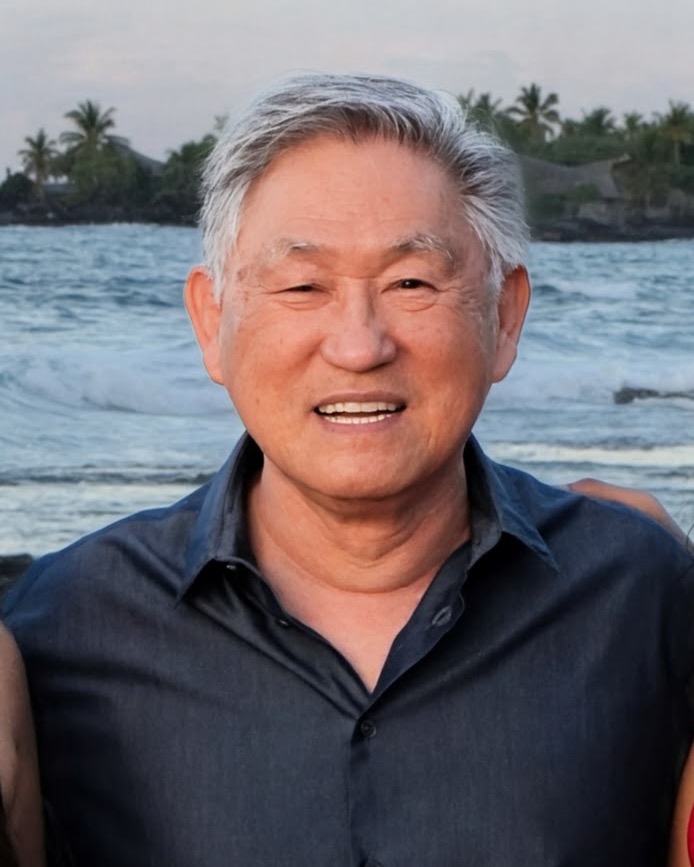
A Lasting Legacy
Dr. William Chao Wei Mow passed away peacefully on June 11, 2026, held in the warmth and love of his family. He will be remembered with profound love and gratitude as a devoted husband, extraordinary father, loving grandfather, cherished uncle, loyal friend, and a steady source of wisdom, encouragement, joy, and unwavering love. He was our guiding light and the foundation of the Mow Family.
Dr. William Chao Wei Mow, lovingly known as Bill, lived a remarkable life defined by courage, intellect, perseverance, reinvention, and deep devotion to his family. Through every chapter, he met life with immense optimism, discipline, resilience, and an unmistakable warmth, always with a smile and laughter on his face.
Early Life & Heritage
Bill was born on March 28, 1936, in Hangzhou, China, the fourth of six sons of Lieutenant General Mow Pan Tsu, of the National Chinese Air Force, and Wong Ay Chuan. Soon after his birth, the family moved from Hangzhou to Chongqing following his father's promotion to General of China's new Air Force. From there, they lived in Chengdu and ultimately Shanghai until 1947. Bill's father was later assigned to be a diplomat at the United Nations in Washington D.C., and in March 1949, Bill's parents and five of their sons moved to New York.
Bill came to America as a young boy, carrying with him the legacy of a proud heritage and the strength that would come to define his life. After settling in Great Neck, New York, his mother opened a small restaurant called the Yangtze River Cafe, its name inspired by the long boat journey they had taken down the famous river when moving from Chengdu to Shanghai. The restaurant helped support them and became central to Bill's early years in America.
Bill attended boarding school at Riverdale Country School. On weekends, after helping his mother at the restaurant, Bill, ever the entrepreneur, would return to campus with 20 egg rolls, selling them for "a quarter apiece to earn his five-dollar allowance for the week." While at Riverdale, Bill was MVP of the soccer team and played in the all-New York City finals throughout high school, scoring 37 goals, a record and achievement that remained a source of pride throughout his life.
A Brilliant Scholar
A brilliant student and gifted young mathematician, Bill went on to Rensselaer Polytechnic Institute in Troy, New York, where he earned his Bachelor of Science in Electrical Engineering in 1959. He loved his RPI days and often recalled how the cold winters, "up to negative twenty-two with windchill," allowed him to focus on his studies. He then went on to earn his Master of Science in Electrical Engineering from the Polytechnic Institute of Brooklyn in 1961, followed by his Ph.D. in Electrical Engineering from Purdue University in 1967, with a focus on computational methods and early machine learning. At Purdue, as Bill described it, he was "single-minded … the most important thing was to pass my qualifying exam and to publish in recognizable journals." In addition to his dissertation, Bill published four papers in leading technical journals on computing while at Purdue University.
"I can do it. I work hard, and I'll figure it out."— Bill, on entering a new industry in 1976
Engineer & Innovator
Bill's first calling was engineering, and he pursued it with the methodical intensity that would later define his business career. Upon receiving his Ph.D., Bill went on eight interviews and, in true Bill Mow fashion, received eight offers. He accepted a position with Litton Industries and moved to Los Angeles, California to be closer to his older brother Harry. There, he spent two years designing computers for guidance and control systems as a program manager, further distinguishing himself as an innovator with a sharp analytical mind and an instinct for solving complex technical problems.
In 1969, Bill founded Macrodata, a company built on his own invention: a method for testing large-scale integrated circuits — the silicon chips then beginning to transform electronics. The company reflected Bill's remarkable ability to combine deep technical expertise with entrepreneurial vision. It quickly established itself as a meaningful force in a fast-evolving industry. The idea was timely and the execution was sharp. Within five years the company's annual sales approached $12 million, and it counted many of the world's leading semiconductor manufacturers among its customers. Macrodata went public in 1973. He traveled the world, spending significant time in Germany and Japan, selling his machines to semiconductor giants including Intel, Motorola, and Siemens. In the mid-1970s, Macrodata was taken private by Cutler-Hammer. As Bill contemplated his next chapter, he took a summer off to spend time with his family and pour himself into one of his great passions: golf. That summer, he won the Club Championship at El Caballero Country Club.
The Bugle Boy Era
In 1976, during a conversation with a friend, Bill was asked if he knew anyone in the import/export business, particularly someone with experience in China and Taiwan. True to form, Bill replied, "I don't, but I can do it. I work hard, and I'll figure it out." With that characteristic confidence and determination, he immediately began his next chapter, founding Buckaroo International Inc., a boutique business focused on wholesale and retail clothing. The first years were hard. By his own account, his computer and engineering background gave him little advantage in an industry driven by taste, timing, and relationships. By September 1980, he had renamed the company Bugle Boy Industries and narrowed its focus to jeans and casual pants, including the "parachute pants" and memorable television commercials ("Excuse me… are those Bugle Boy jeans?") that became defining fixtures of the decade. Bugle Boy became known for rapidly cycling through new styles and colors, responding to the market with the quick-turnaround manufacturing and overseas production that he orchestrated with characteristic precision.
Bill's engineering instincts became the company's secret weapon. He invested early and heavily in computerized management systems, electronic design transmitted directly to factories, real-time inventory tracking, and Electronic Data Interchange with retailers — tools that let a clothing company run with the discipline of a technology firm. Using that advantage, Bugle Boy roughly doubled in size year after year in the late 1980s. Under Bill's leadership, Bugle Boy grew from a small retail venture into a major force in casual apparel for adults and children, with merchandise sold in more than 7,000 stores and annual sales exceeding $1 billion. His entrepreneurial vision, market instinct, and determination helped establish Bugle Boy as one of the most recognizable brands of its era. He later expanded the business internationally, including into China. When Bill sold Bugle Boy in 2001, he entered a new season of life with gratitude, grace, endless smiles, and an infectious sense of joy, carrying forward the same unwavering devotion to family that remained at the heart of all he did.
A Life of Joy & Family
Throughout his life, Bill found great joy in golfing (Cypress, Pebble Beach and Riviera Country Club among his favorite courses and five hole-in-ones), traveling the world with his family, building family homes to hold decades of memories, collecting special cars, including his beloved red Ferraris and customized Bentleys, enjoying an afternoon Haagen Dazs coffee ice cream cone, watching professional sports, hosting family gatherings with his wife Rosa, curating meaningful holiday traditions, listening to classical and classic rock music, and creating photo albums with his signature commentary that preserved the family's travels and most cherished moments. His greatest joys in life were his beloved wife Rosa, his children, and his grandchildren. Nothing lit up his face more in his later years than seeing his grandchildren and watching them grow.
He was a man of immense strength, character, and heart, whose warmth, ever-present smile, infectious laugh, and genuine kindness left a lasting impression on everyone fortunate enough to know him. He carried himself with dignity, determination, and quiet confidence, approaching life with optimism, discipline, integrity, and grace. As a husband, Bill was devoted, loyal, and deeply loving, a steady partner whose strength, warmth, and unwavering support were at the center of his family. As a father, he was generous in every way. Despite the demands of his career, he always made time for his children and made them feel deeply loved, whether through trips to Disneyland, rounds of golf, quick rides in his Ferrari for ice cream, simple shared family moments, or the joy of gathering everyone around the table. Bill and Rosa loved hosting dinner parties at "Chez Mow," where family and friends were welcomed with warmth, joy, Rosa's wonderful food, and Bill's unmistakable laugh. The experience was so beloved it earned its own special "32 out of 30" Zagat rating among those lucky enough to be invited.
A Belief in Education
Education held a special place in Bill's heart. Having benefited from scholarships throughout his own educational journey, he understood firsthand the life-changing power of opportunity and remained deeply grateful for the generosity of those who had helped open doors for him. His mother instilled in him the belief that education was the foundation of success, not only as a path to achievement, but as a way to build character, confidence, resilience, and discipline. This conviction shaped his own journey and the way he encouraged his children, grandchildren, and others to approach life with curiosity, perseverance, and purpose. Bill's vision, judgment, and counsel were sought by many, and he gave generously of his time and insight to the institutions and communities he cared about most. He served on the Boards of Directors of Riverdale Country School in New York City, Rensselaer Polytechnic Institute in Troy, New York, and the John Thomas Dye School in Los Angeles, bringing thoughtfulness, integrity, discipline, and purpose to each.
Guided by these values, Bill gave generously to the institutions that shaped his life, including Riverdale Country School, Rensselaer Polytechnic Institute, and Purdue University, as well as the schools that shaped the lives of his children, including John Thomas Dye, Harvard-Westlake, Columbia University, and the University of Pennsylvania. Whether establishing scholarships and financial aid programs, donating early computer labs, providing Bugle Boy clothing to support important causes, speaking with students, delivering commencement addresses at Rensselaer Polytechnic Institute and Purdue University, or mentoring others, Bill gave thoughtfully and wholeheartedly. His impact continues to be felt through the institutions he loved, including William C.W. Mow Hall at Riverdale Country School, the William C.W. Mow annual scholarship program at Rensselaer Polytechnic Institute, and a quilt he donated to John Thomas Dye, now permanently displayed in JTD Hall. Rooted in gratitude and humility, Bill's generosity reflected his belief in opening doors, strengthening institutions, and helping future generations build strong foundations of their own.
Honors & Recognition
Bill was recognized with many awards and honors throughout his life that reflected the breadth of his accomplishments and the lives he touched. These included the Southern California Entrepreneur of the Year Award in 1989; the Lifetime Membership in the Distinguished George M. Low '48 Society of Rensselaer Polytechnic Institute in 1989; the Distinguished Alumni Entrepreneur of Rensselaer Polytechnic Institute in 1990; the Juvenile Diabetes Foundation's Father of the Year Award in 1991; the Trans-Pacific Golden Image Award; the World Trade Hall of Fame Award in 1994; the Purdue University Distinguished Engineering Alumnus Award in 1995; and the Distinguished Alumnus Citation of The Polytechnic Alumni in 2000.
Above all, Bill loved deeply and fully. His devotion to his family was unwavering, and he took immense pride in the happiness, growth, and lives of those he cherished. A man of intellect, resilience, and humanity, Bill understood hardship and reinvention, and met each chapter of life with courage, resolve, and grace. He will be remembered not only for the remarkable life he built, but for the love he gave so freely, the example he set, and the lasting impact he had on others. Whether offering guidance, sharing wisdom, or telling a story with humor, Bill had a rare ability to inspire and uplift those around him. Though his absence leaves an immeasurable void, he leaves behind a legacy of perseverance, achievement, generosity, and love, carried forward by the family he cherished, the values he embodied, and the future generations his life story will continue to inspire.
Survived By
Bill is survived by his beloved wife of 42 years, Rosa Mow; his four children, Genevieve Cyd Mow of Los Angeles, California, Katherine Mow-McCarthy and her husband, Brian, of St. Paul, Oregon, Hillary Cyd Mow Cervieri and her husband, Peter, of Los Angeles, California, and Jason Shen Mow and his partner, Elle, of Los Angeles, California; and his seven cherished grandchildren, Samuel Bennett Mow Goodman, Clara Mei McCarthy, Maggie Ling McCarthy, Kellan Patrick McCarthy, Valentina Willa Mow Cervieri, Carolina Sofia Mow Cervieri, and Gemma Cervieri. He is also survived by his brothers, Maurice Mow and his wife, Margaret, of San Francisco, California, and Van Mow and his wife, Barbara, of Westchester, New York. He was predeceased by his three brothers, David Mow, Harry Mow, and Donald Mow, and is survived by his sister-in-law, Connie Mow. He also leaves behind many nieces, nephews, great-nieces, and great-nephews.